Most naming projects start with creativity and end with a legal check. It is better the other way round. A name that turns out to clash with an existing trademark can mean a forced rebrand, wasted signage and print, and the loss of whatever reputation the name had built. A few hours of checking at the start costs far less.
This article explains the basics of US trademarks for business owners. It is general information, not legal advice. For a name you plan to invest in heavily, a trademark attorney’s clearance search is money well spent.
What a trademark is
The US Patent and Trademark Office (USPTO) defines a trademark as any word, phrase, symbol or design, or a combination of them, that identifies your goods or services. Your business name, your product names and your logo can all be trademarks.
Rights come from use. Once you use a mark for your goods or services, you have some rights in it, but only in the area where you trade. Federal registration gives broader rights, nationwide. Registering a company name with your state, or buying a domain name, is a separate thing and doesn’t give you trademark rights on its own.
Key takeaway
A company registration and a domain name aren’t trademarks. Check the name as a trademark before you commit to it.
Strong marks and weak marks
The USPTO ranks marks on a scale of distinctiveness. Stronger marks are easier to register and to defend; weaker ones may not be protectable at all.
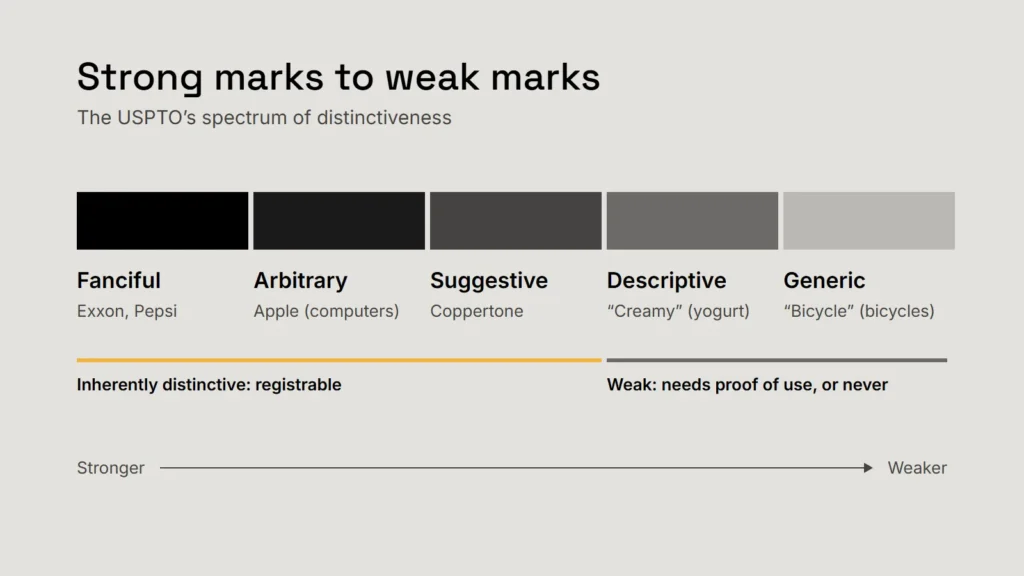
- Fanciful: invented words with no meaning except as a brand. The USPTO’s examples are Exxon and Pepsi.
- Arbitrary: real words with no connection to what you sell, such as Apple for computers.
- Suggestive: words that hint at a quality without stating it, such as Coppertone for sun-tanning products.
- Descriptive: words that simply describe the product, such as “Creamy” for yogurt. Generally registrable only after long use makes customers see them as a brand.
- Generic: the ordinary name for the product, such as “Bicycle” for bicycles. Never registrable.
This creates a familiar tension. Owners often prefer descriptive names because they explain the business instantly. Those are exactly the names that are hardest to protect. A suggestive or arbitrary name, supported by a clear tagline, usually serves a growing business better.
The names that explain themselves most easily are the hardest to own.
Search before you fall in love with a name
The most common reason the USPTO refuses an application is a likelihood of confusion with an existing mark: the names are similar enough, and the goods or services related enough, that customers might think they come from the same source. The names don’t need to be identical, and the businesses don’t need to be in the same town.
- Search the federal register with the USPTO’s free trademark search system, looking for similar spellings and sounds, not just exact matches.
- Search state registers where you trade. The USPTO’s examiners only check federal records, so this part is up to you.
- Search the web, app stores, marketplaces and social platforms for businesses already using the name without registering it. Their rights from use still count.
- Keep a shortlist. Take three to five candidates into the search rather than one favourite.
TM, SM and ®
| Symbol | Meaning | Who can use it |
|---|---|---|
| ™ | A trademark claimed for goods | Anyone, without filing |
| ℠ | A service mark claimed for services | Anyone, without filing |
| ® | A federally registered mark | Only after registration, and only for the goods and services listed in it |
Registering with the USPTO
An application goes through four broad stages: application, examination by a USPTO attorney, publication so that others can oppose it, and registration. Since 18 January 2025, the base filing fee is $350 per class of goods or services, with surcharges if the application is missing required information ($100 per class), uses a free-text description instead of the USPTO’s pre-approved list ($200 per class), or runs long. Registration must then be maintained with periodic filings to stay alive.
Businesses based in the US can file without an attorney. Applicants based outside the United States must be represented by a US-licensed attorney. That matters for international companies entering the US market, including those working with partners abroad.
Where this fits in a brand project
- Agree the brief and positioning first, so the name has a job to do.
- Generate a long list, then shortlist names that are suggestive, arbitrary or invented.
- Run the searches on the shortlist before any logo or identity design.
- Ask a trademark attorney to check the finalist, and file early.
- Then design the identity, secure the domain and social handles, and launch.
Checklist
- Prefer suggestive, arbitrary or invented names.
- Search federal, state and unregistered use before designing.
- Use ® only once registered.
- Budget $350 or more per class, and an attorney if you are based outside the US.
Related service
Naming, identity systems and guidelines, built on a name you can keep.