This is general information about US copyright, not legal advice. For anything valuable or unusual, speak to a lawyer.
The US Copyright Office explains that copyright exists automatically in an original work once it is fixed in a tangible form, and the Copyright Act says copyright belongs initially to the author: the person who created the work. For a logo, website design, illustration or photograph, that is usually the designer, developer or photographer, unless something changes it.
Two ways the business can own it
1. Work made for hire
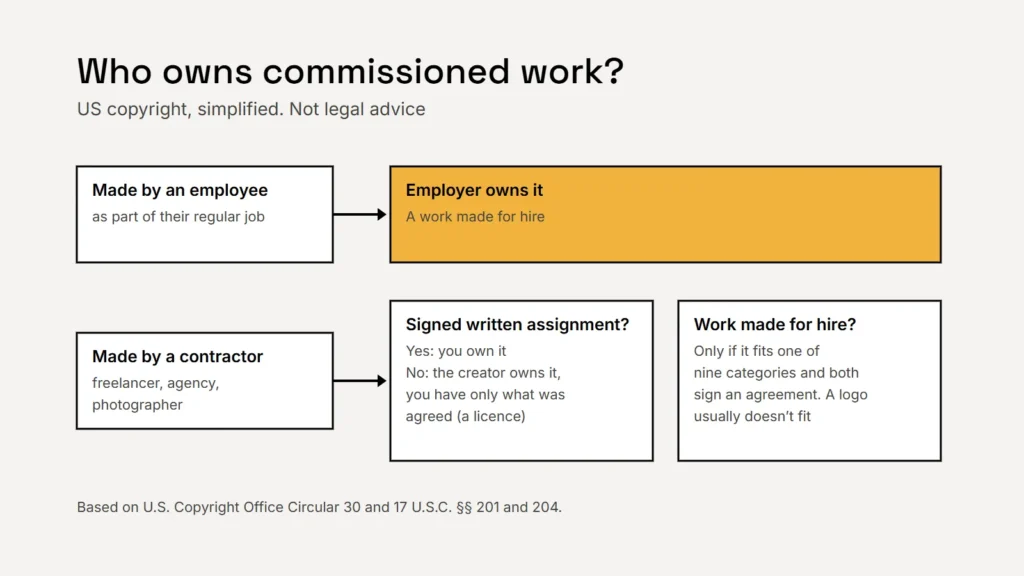
The Copyright Office’s Circular 30 explains that a work is “made for hire” in two situations. The first is a work created by an employee as part of their regular duties. Then the employer is the author and owner.
The second covers commissioned work, but only in nine specific categories: a contribution to a collective work, part of a motion picture or other audiovisual work, a translation, a supplementary work, a compilation, an instructional text, a test, answer material for a test, or an atlas. And only if both parties sign a written agreement saying it is a work made for hire. The Office is clear that if a work fails any of these requirements, it is not a work made for hire.
Key takeaway
A logo designed by a freelancer or agency usually doesn’t fit those nine categories. Calling it “work for hire” in a contract may not make it one.
2. A written assignment
The more reliable route for commissioned work is an assignment: the creator transfers the copyright to you. The Copyright Act says a transfer of copyright ownership isn’t valid unless it is in writing and signed by the owner of the rights, or their authorised agent. An email saying “it’s yours” or an invoice marked paid isn’t enough on its own.
Buying the file isn’t buying the copyright
The Act also says that owning a physical copy doesn’t in itself convey any rights in the copyrighted work. Receiving the logo files, or prints from a photo shoot, gives you the files, not the copyright. Without an assignment or licence, what you can do with them depends on what was agreed.
Paying for the work and owning the copyright are two different things. The contract connects them.
What a good agreement covers
| Point | Why it matters |
|---|---|
| A signed assignment of copyright on payment | Transfers ownership in the way the law requires |
| Exactly what is included | Final logo, alternative versions, source files, website code, photos |
| Third-party material | Stock images, fonts and plugins remain under their own licences |
| The designer’s portfolio use | Many creators ask to show the work; agree it explicitly |
| Credit for the creator | Agree whether, and where, the creator is credited |
| Photos of people | Model releases for staff or customers who appear |
Things copyright doesn’t protect
Copyright isn’t the only protection a brand needs. The Copyright Office says names, titles, short phrases and slogans can’t be protected by copyright, though they may be protected under trademark law. Your business name and tagline are matters for trademark: see our article on trademark basics. And work generated by AI without human authorship raises its own questions: the Copyright Office has published guidance on registering works containing AI-generated material.
Registration and termination
- Registration isn’t required for copyright to exist, but the Copyright Office notes that for US works it is needed before filing an infringement suit, and registering before infringement or within three months of publication makes statutory damages and attorney’s fees available.
- Assignments can sometimes be ended. US law lets authors terminate transfers in some circumstances after 35 years. The Copyright Office notes that works made for hire can’t be terminated in this way. Ask a lawyer whether this matters for your brand.
Checklist
- Assume the creator owns it until a signed agreement says otherwise.
- For freelancers and agencies, use a written assignment.
- List exactly what is transferred, including source files.
- Keep third-party licences on file.
- Protect names and slogans with trademark, not copyright.
For using other people’s images on your site, see our guide to using images legally. For organising the files you receive, see logo file formats explained.
Sources
- U.S. Copyright Office: Circular 30, Works Made for Hire
- U.S. Copyright Office: Circular 1, Copyright Basics
- U.S. Copyright Office: Circular 33, Works Not Protected by Copyright
- U.S. Copyright Office: Copyright Act, chapter 2 (sections 201–205)
- U.S. Copyright Office: Termination of transfers
- U.S. Copyright Office: Copyright and artificial intelligence