Ask how long a website takes and you’ll hear anything from “a weekend” to “six months”. Both can be true. A one-page site on a website builder can go live in a day; a large custom site with many integrations can take months. For a typical small service business, the honest answer is a few weeks of build time, plus however long it takes to gather content and make decisions.
Typical timelines by size
| Website | Pages | Typical build time |
|---|---|---|
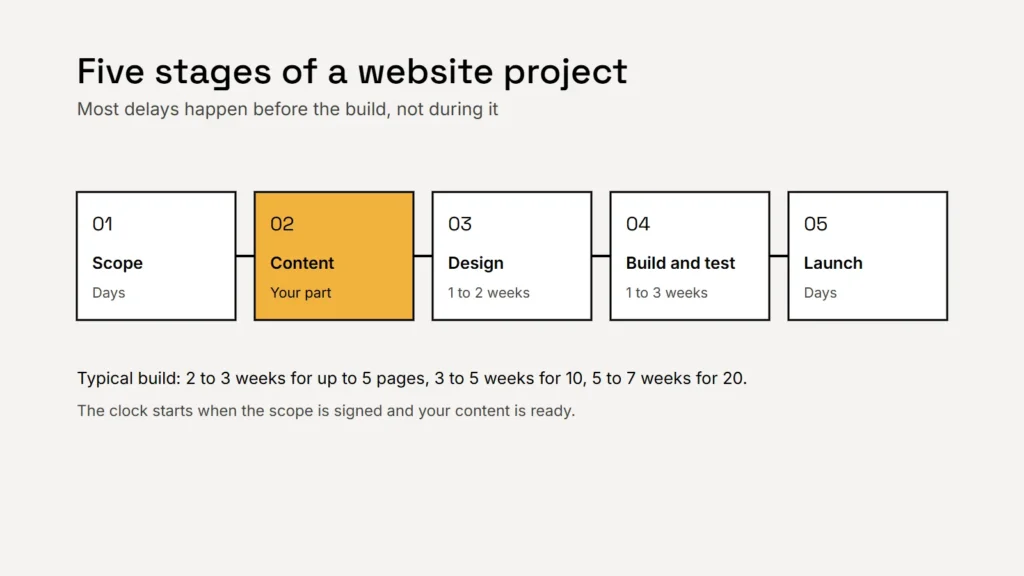
| Small, simple site | Up to 5 | 2 to 3 weeks |
| Established service business | Up to 10 | 3 to 5 weeks |
| Larger or multi-service site | Up to 20 | 5 to 7 weeks |
| Online store, portal or complex booking | Varies | Scoped individually, often longer |
Key takeaway
The clock that matters starts when the scope is agreed and your content is ready, not when you first get in touch.
What happens each week
- Agree the scope. Pages, features, who supplies what and the launch date, in writing. Usually a few days.
- Gather content. Words, photos, logos, reviews, service details and logins for your domain and hosting.
- Design. The look and layout, shared for feedback, with an agreed number of revision rounds.
- Build and test. The working site, checked on phones and desktops, with forms and phone links tested.
- Launch and check. Go live, set up redirects if you’re replacing a site, submit the sitemap and watch for errors.
What slows projects down
Delays are rarely technical. The common ones are:
- Content that isn’t ready. Service descriptions, team bios and photos take longer to write and gather than almost anyone expects.
- Slow or scattered feedback. Several people giving feedback at different times, or long gaps between rounds.
- Scope that keeps growing. New pages or features added mid-project. Each is reasonable on its own; together they move the date.
- Missing access. Nobody knows who holds the domain or hosting login. See why you should own your domain.
- Third-party set-up. Booking systems, payment providers or email services that need their own accounts and approvals.
Content, not code, decides most launch dates.
How to launch sooner
- Start gathering words and photos before the project begins: one page per service, a short about section and real photos.
- Choose one person to collect feedback and give a single, consolidated reply each round.
- Agree the page list up front, and save extra ideas for a second phase after launch.
- Find your domain, hosting and email logins now, and make sure they’re in your business’s name.
- Launch with what’s ready, then add articles, galleries and extra pages over the following weeks.
After launch: when will Google show it?
A new site doesn’t appear in Google instantly. Search engines need to discover and crawl it first. You can speed this up by submitting your sitemap and requesting indexing of key pages in Google Search Console. Ranking well for competitive searches then takes months of useful content and steady improvements, which is why it pays to launch a solid site early rather than a perfect one late.
For the money side of the same decision, read our guide to what a small business website costs.
Checklist
- Expect 2 to 7 weeks of build time for most small business sites.
- Get content ready before the project starts.
- One person gives feedback.
- Agree the page list up front.
- Launch, then keep improving.
Related service
Fixed-price websites with clear timelines: Starter in 2 to 3 weeks, Business Growth in 3 to 5 and Premium in 5 to 7.