Most agent websites look alike: a search bar, some featured listings and a smiling headshot. Listing search matters, but it’s rarely why someone chooses an agent. People hire the agent who seems to know their area, understands their situation and will look after them. That’s what your website needs to show.
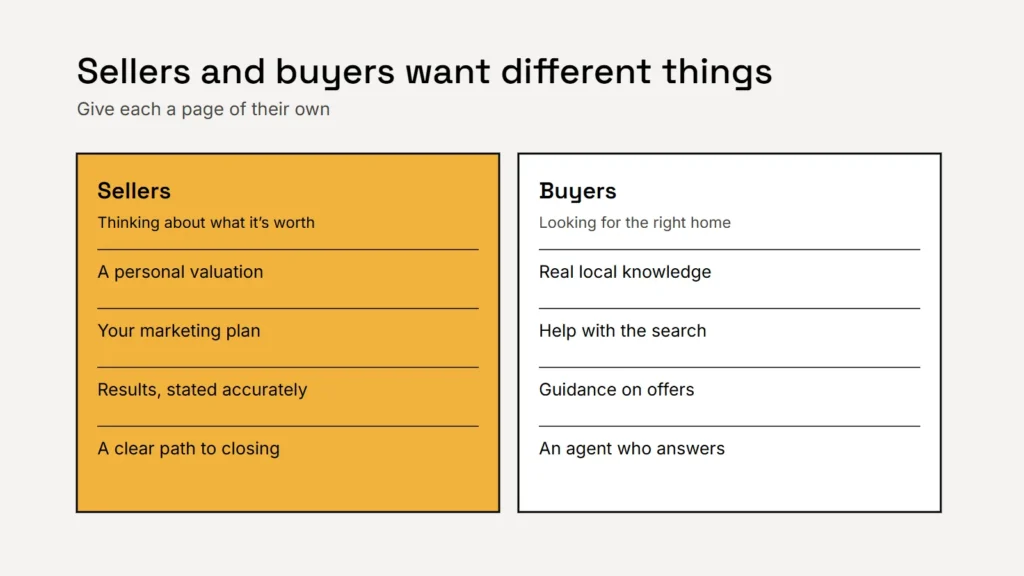
Separate pages for sellers and buyers
Sellers and buyers have different worries, so give each a page of their own.
- Sellers want to know what their home might be worth, how you’ll market it, what results you’ve had and what happens from listing to closing. Offer a home value request, and be clear it leads to a personal estimate, not an instant guarantee.
- Buyers want local knowledge, help finding the right home, guidance on making offers and an agent who answers quickly. Explain how you work with buyers and what it costs them, stated accurately.
Key takeaway
Listings show what’s for sale. Your seller and buyer pages show why someone should work with you.
Neighborhood pages with real local knowledge
Area pages can rank well and win trust, but only if they say something genuinely useful: what the neighborhood is like, the kinds of homes, how the market has moved recently and what buyers usually ask. Copying the same text for every town can break Google’s spam policies on doorway pages. A few well written area pages beat dozens of thin ones.
Fair housing: choose words carefully
The Fair Housing Act makes it unlawful to make, print or publish any advertisement for the sale or rental of a dwelling that indicates a preference, limitation or discrimination based on race, color, religion, sex, handicap, familial status or national origin (42 U.S.C. 3604(c)). That applies to your website too. In practice:
- Describe the property and its features, not the kind of people who should live there.
- Avoid phrases like “perfect for young families” or “ideal for singles”.
- Describe neighborhoods by facts such as parks, transit and amenities, not by who lives there.
- Include the fair housing statement or logo your brokerage uses.
Describe the home and the area. Never describe who should live there.
Brokerage details and honest claims
Most states require real estate advertising to show the name of the brokerage, and some have rules on how teams may be named. Members of the National Association of REALTORS® also follow its Code of Ethics, which requires honesty and truthfulness in advertising. Keep sales figures, awards and rankings accurate and dated, and check your state’s license law and your brokerage’s policy before you publish.
Make the first conversation easy
- A tappable phone number and a short contact form on every page.
- Clear reasons to get in touch: a home valuation, a buyer consultation or a question about an area.
- A photo and a short, personal introduction, so people know who they’ll speak to.
- Real reviews only. See how to ask for reviews.
Checklist
- Separate seller and buyer pages.
- A few genuinely useful neighborhood pages.
- Fair housing safe wording on every page.
- Your brokerage named as your state requires.
- Accurate, dated claims.
- An easy first contact.
Related service
Websites for real estate agents
Real estate websites for agents and teams, with seller and buyer pages, local content and contact forms that start conversations.