
Most people who are happy with a business never think to leave a review unless they’re asked. So asking is worth doing. But since 21 October 2024, the US Federal Trade Commission has had a rule specifically about consumer reviews, and Google applies its own, stricter policy to reviews on Maps and Business Profiles. Here is how the two fit together.
This is general information, not legal advice. For anything unusual, speak to a lawyer.
The FTC rule in brief
The FTC’s Consumer Reviews and Testimonials Rule (16 CFR Part 465) took effect on 21 October 2024. According to the FTC’s own questions-and-answers guide, it covers:
- Fake reviews, including reviews from people who never used the business, and buying reviews you knew or should have known were fake.
- Buying reviews by sentiment: offering anything in return for a review that must be positive (or negative about a competitor), whether that condition is stated or implied.
- Insider reviews: reviews by staff, owners or their relatives without a clear disclosure of the connection.
- Company-controlled “independent” review sites that are presented as independent.
- Review suppression: using threats or false accusations to get reviews removed.
- Fake social media indicators, such as bought followers or views.
The FTC notes that courts can impose civil penalties for knowing violations. Its guide also says the rule doesn’t ban incentives in themselves, as long as there is no express or implied requirement that the review be positive.
Google is stricter than the law
Google’s Maps content policy goes further. It says businesses must not offer incentives such as payment, discounts or free services in exchange for posting a review, at all, regardless of sentiment. It also bars discouraging negative reviews and selectively soliciting positive reviews, a practice often called review gating.
| Practice | FTC rule | Google policy |
|---|---|---|
| Asking every customer for an honest review | Allowed | Allowed |
| A discount for any review, good or bad | Not banned by the rule | Not allowed |
| A reward only for positive reviews | Prohibited | Not allowed |
| Asking only customers you think are happy | Not in the rule, but the FTC says it could violate the FTC Act | Not allowed |
| Staff reviewing their own employer without disclosure | Prohibited | Not allowed (conflict of interest) |
| Reviews from people who never used you | Prohibited | Not allowed |
Key takeaway
If you follow Google’s policy, you’ll almost always be inside the FTC rule too: ask everyone, offer nothing, and never filter.
A routine that works
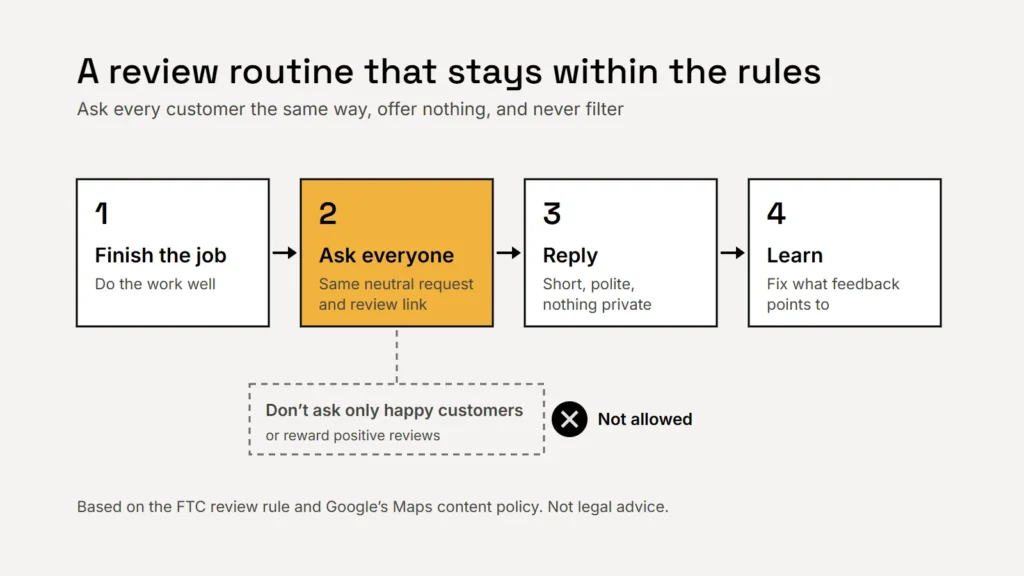
- Get your link. Google Business Profile lets you copy a review link or download a QR code from your profile’s “Get more reviews” option.
- Ask everyone, the same way. Add the link to your thank-you email, invoice or receipt, and put the QR code where customers finish their visit.
- Time it well. Ask shortly after the job is done, while the experience is fresh.
- Keep the request neutral. “Tell us how we did” is fine. The FTC gives “tell us how much you loved your visit” with a reward as an example of implying the review should be positive.
- Don’t ask for specific wording, keywords or a star rating. Google’s policy bars requesting that specific content be included.
Ask every customer, offer nothing in return, and never filter out the unhappy ones.
Replying to reviews
Google recommends replying to reviews, keeping replies short, polite and personal, and responding in a timely way. With negative reviews, apologise where it’s appropriate and avoid personal attacks. One rule matters especially for health, therapy and legal businesses: never confirm that the reviewer is a client or mention any detail of their case in a public reply. Our article on privacy for therapy practice websites explains why.
Testimonials on your own website
The same honesty applies to testimonials on your site. Use real customers’ words, with their permission, and don’t edit them in a way that changes their meaning. Don’t expect star ratings in Google from your own testimonials either: Google says a business’s pages are ineligible for review stars when it controls the reviews about itself. Our guide to structured data covers what is worth marking up.
Checklist
- Ask every customer, in the same neutral way.
- Offer no reward for Google reviews.
- Never gate, filter or discourage negative reviews.
- No undisclosed reviews from staff or family.
- Reply politely, and never reveal private details.
Reviews feed directly into local search. Our guide to local search for service businesses shows how they fit with the rest of your Business Profile.