
Ask what a website costs and the honest answer is “it depends”. What it depends on is mostly the same in every industry: the number of pages, how custom the design is, the features you need and who writes the content. What differs by industry is which of those you need, and the rules or expectations you have to get right.
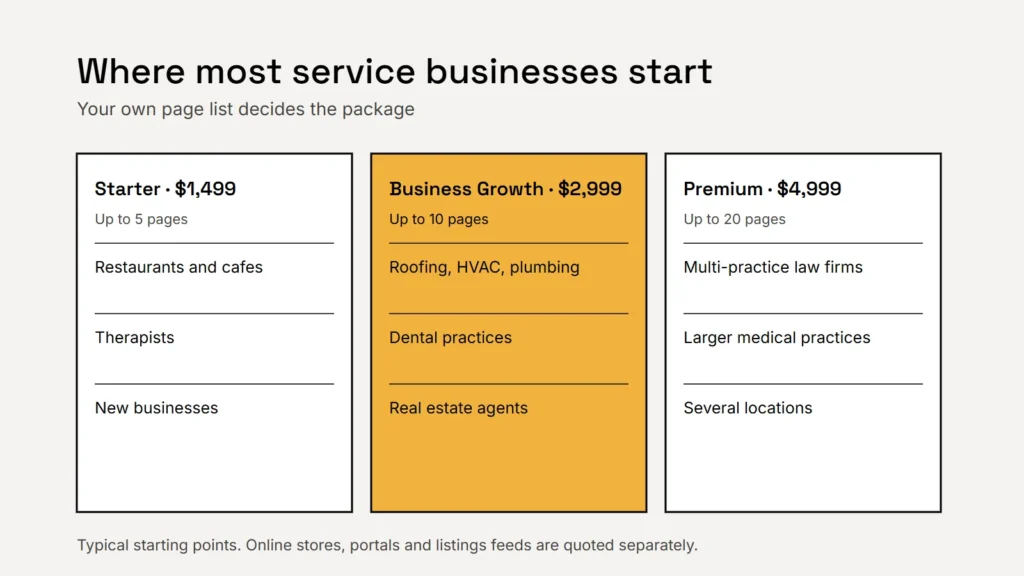
To make this concrete, the prices below are our own fixed packages: Starter at $1,499 for up to 5 pages, Business Growth at $2,999 for up to 10 pages and Premium at $4,999 for up to 20 pages. Other agencies price differently, but the same factors drive their quotes too.
Industry by industry
| Business | Pages it usually needs | What adds scope | Where most start |
|---|---|---|---|
| Restaurant or cafe | Home, menu, about, events, contact | Reservation and ordering links (third-party tools) | Starter, $1,499 |
| Therapist or counselor | Home, about, specialties, fees, contact | Privacy-aware forms, booking links | Starter, $1,499 |
| Roofing, HVAC or plumbing | A page per main service, service area, reviews, quote | Photo upload on quote forms, financing pages | Business Growth, $2,999 |
| Dental practice | Services, new patients, insurance, team, booking | Booking and forms that handle health information | Business Growth, $2,999 |
| Real estate agent or team | Buyers, sellers, area pages, about, valuation request | Listings feeds (a separate subscription) | Business Growth, $2,999 |
| Law firm | A page per practice area, attorney profiles, results, contact | Attorney review of every claim; intake forms | Business Growth or Premium |
| Medical practice | Services or conditions, providers, insurance, locations | Patient portal links, accessibility and privacy review | Business Growth or Premium |
What each industry has to get right
- Law firms. The ABA’s Model Rule 7.1 says a lawyer must not make false or misleading communications about their services, and each state has its own advertising rules. Every page, especially results and testimonials, needs attorney review before launch. That review time is part of the schedule.
- Dental and medical practices. Forms, booking tools and tracking can involve health information. HHS guidance warns that tracking technologies on some health websites can disclose protected information. Medical practices that receive HHS funding should also check HHS’s Section 504 rule, which covers accessible web content.
- Trades. Customers call from phones, often in a hurry. Tap-to-call on every page, clear service areas and fast pages matter more than visual extras. See local search for service businesses.
- Real estate. Property listings usually come from a third-party feed with its own monthly fee. The website itself is mostly area guides, seller and buyer pages and a valuation request.
- Restaurants. Most visitors want the menu, hours and a way to book or order. A small, fast site that is easy to update beats a large one.
Key takeaway
The industry rarely changes the price. The page count, features and content do.
Running costs in every industry
Whatever you do, budget for costs that sit outside the build: the domain, hosting, any booking, listings or ordering subscriptions, and maintenance. Our guide to website maintenance costs covers the last one, and our small business website cost guide covers the full list.
Count your pages first. It’s the quickest way to know what your website will cost.
Work out your own estimate
Our website cost calculator asks six quick questions and recommends a package, with care plans and anything quoted separately. If you already have a site and aren’t sure what it needs, ask for a free website review.
Checklist
- Count the pages you need, one per main service.
- List the features that need third-party tools.
- Allow time for industry review: attorneys, compliance or clinical staff.
- Budget for running costs, not just the build.
Related service
Six quick questions, real fixed prices and a clear list of anything quoted separately.