
Clients considering an aesthetic treatment want to see what it can actually do. Good before-and-after photos answer that better than any paragraph. But they are also photos of patients, used to sell a medical service, so consent, fairness and accuracy matter more here than on almost any other kind of website.
This is general information, not legal advice. Rules vary by state and by treatment, so check your approach with your medical director or a healthcare attorney.
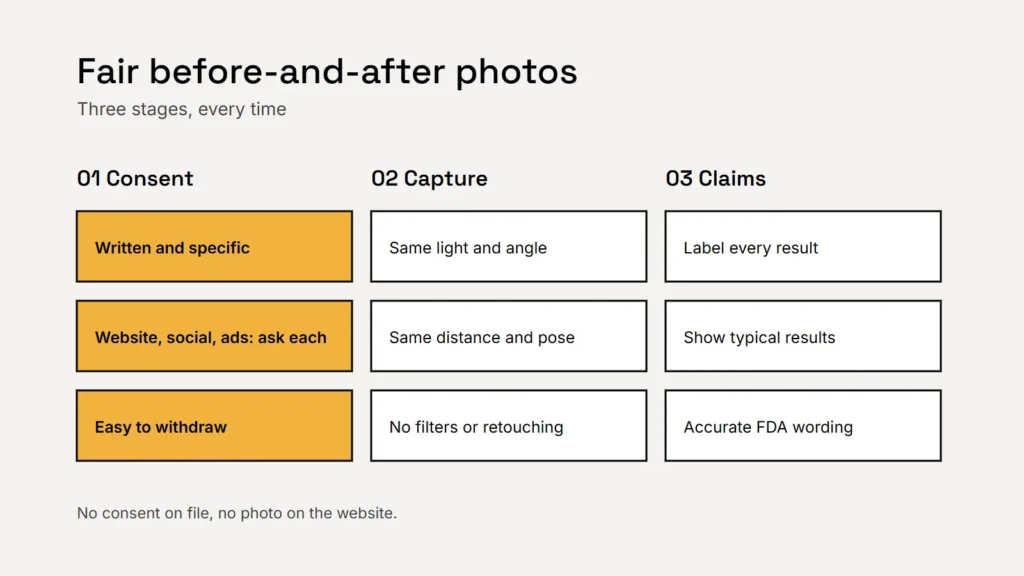
Start with written consent
Get each client’s written permission before any photo goes on your website, and keep it on file. A useful consent form is specific about:
- Which photos. The treatment, the date and the images included.
- Where they will appear. Your website, social media, ads or printed materials. Ask about each one separately.
- Whether the face is shown. Let clients choose cropped images if they prefer.
- How long, and how to withdraw. Explain how to ask for a photo to be removed, and remove it promptly when they do.
If your practice is a HIPAA covered entity, using patient information for marketing generally requires the patient’s written authorization. Full-face photographs and comparable images are on HHS’s list of identifiers, so cropping alone may not make a photo anonymous. Even where HIPAA doesn’t apply, state privacy and professional rules may, and clear written consent protects both you and your clients.
Key takeaway
No consent on file, no photo on the website.
Take photos that compare fairly
A comparison only means something if the only thing that changed is the treatment. Agree a simple photo routine and use it every time:
- The same lighting, background, camera distance and angle.
- The same expression and pose, with hair pulled back the same way.
- No makeup in either photo, or the same makeup in both.
- No filters, retouching or editing beyond cropping and resizing.
- A note of how long after treatment the “after” photo was taken.
Before you upload, strip the photo’s hidden file data (such as the location and the camera’s date stamp). Many phones add it automatically.
Label every result honestly
A short label next to each photo helps clients understand what they’re looking at, and keeps the comparison fair.
| Label | Example |
|---|---|
| Treatment | Dermal filler, cheeks |
| Sessions | 1 session |
| Time after treatment | Photographed 2 weeks after |
| Provider | The provider who performed it, if you name providers |
| Results | Individual results vary. Typical results for this treatment are described on the treatment page. |
The FTC’s Endorsement Guides say that if you show results that aren’t what people can generally expect, you need to clearly disclose what they can generally expect. A vague “results may vary” line on its own may not be enough. The safest approach is to show typical results, and explain on each treatment page what most clients see and how long it lasts.
Show the results most clients can expect, not just your best case.
Keep treatment claims accurate
- Back up health claims. The FTC expects claims about a treatment’s safety or results to be supported by competent and reliable scientific evidence. Avoid words like “permanent”, “painless” or “no downtime” unless they are true for most clients.
- Use the right FDA wording. Many aesthetic devices reach the market through FDA 510(k) clearance, which is not the same as FDA approval. Describe a device the way its manufacturer’s clearance or approval actually supports.
- State credentials precisely. Name who performs each treatment and their actual qualifications, as your state allows.
- Use real reviews only. The FTC’s rule on fake reviews bans fake or bought reviews and testimonials. See how to ask for reviews without breaking the rules.
Build the gallery with care
- Group photos by treatment, next to the treatment they show, rather than in one long gallery.
- Make it quick for your team to remove a photo when a client withdraws consent.
- Add descriptive alt text that names the treatment, not the client.
- Use only your own photos. Manufacturer or stock results aren’t your clinic’s work; see using images legally.
- Keep advertising pixels and tracking off pages where clients share health information. Our guide to privacy, tracking and forms for health practices explains why.
Checklist
- Written, specific consent before any photo is published.
- The same light, angle and distance for both photos, with no retouching.
- A label on every result, showing typical outcomes.
- Accurate claims and the right FDA wording.
- Real reviews only.
- A simple way to remove a photo on request.
Related service
Treatment pages, online booking and consent-based galleries for US med spas and aesthetic clinics.
Sources
- FTC: FTC’s Endorsement Guides: What People Are Asking
- FTC: Health Products Compliance Guidance
- FTC: Final rule banning fake reviews and testimonials (August 2024)
- HHS: HIPAA Privacy Rule and marketing
- HHS: Guidance on de-identification of protected health information
- FDA: Is it really “FDA approved”?