A homeowner planning a new patio, a full backyard or a year-round maintenance contract is about to spend real money. Before they call, they want to see work like theirs, understand how you work and get a feel for the budget. A website that answers those questions does a lot of the selling before the site visit.
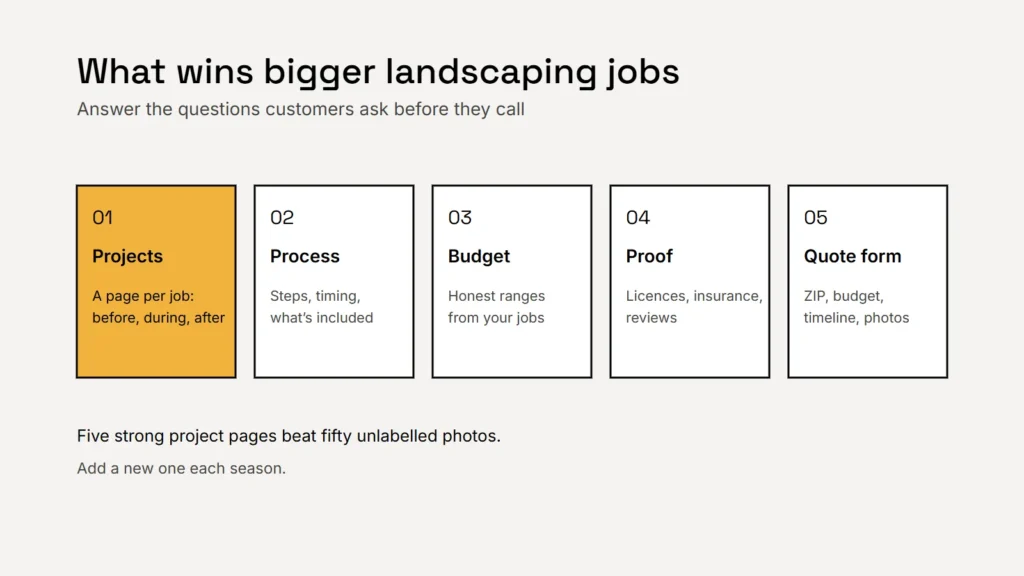
1. Project pages, not just a gallery
A grid of nice photos shows you do good work. A short page for each major project shows you can handle their project. For each one, include:
- What the client wanted and the problem you solved, such as drainage, a slope or a tired lawn.
- The scope: patio, planting, lighting, irrigation, walls.
- Materials, roughly how long it took and the town, if the client agrees.
- Before, during and after photos. The “during” shots show the groundwork customers never see.
- A quote from the client, if they’re happy to give one.
Five strong project pages that match the jobs you want will do more than fifty unlabelled photos. Add a new one each season.
2. Show how you work
Bigger jobs feel risky. Explain your process in plain steps (first visit, design, quote, build, aftercare) with typical timeframes and what the customer needs to decide at each stage. Say what your quote includes, how payments are scheduled and what happens if the weather delays work. If you offer financing, design visits or warranties, explain the terms exactly.
3. Help customers budget
Many people won’t call until they know whether they’re in the right range. You don’t need a price list. Give honest guidance from your own jobs, such as “Most of our patio projects start from…”, and explain what moves the price:
| What affects the price | Why |
|---|---|
| Size and design | More area and more complex shapes take more material and labour. |
| Access | Narrow access or no room for machines means more work by hand. |
| Ground and drainage | Slopes, poor soil and water problems add groundwork. |
| Materials | Natural stone, pavers, timber and plants vary widely in cost. |
| Permits | Some walls, drainage and structures need local approval. |
4. Give them reasons to trust you
- Licences and insurance, where your state or town requires them, stated accurately with numbers if customers can check them.
- Certifications and memberships you actually hold.
- Reviews, especially for larger projects. See how to ask for reviews.
- Your team, your equipment and how long you’ve been in business.
- Warranties on workmanship or plants, with the terms spelled out.
5. A quote form that qualifies
For bigger jobs, a slightly longer form is worth it: it saves wasted site visits and shows the customer you take projects seriously. Keep every field optional except contact details and the service.
| Field | Why it helps |
|---|---|
| Service needed | Sends design-build and maintenance enquiries to the right person. |
| ZIP code | Tells you straight away if they’re in your area. |
| Budget range | Lets you focus on the projects you want. |
| Timeline | Spots the urgent jobs and the ones for next season. |
| Photo upload | Helps you scope and price before the visit. |
Test the form every month, and make the phone number tappable on every page. Our guide to contact forms that work has more.
Five strong project pages that match the jobs you want will do more than fifty unlabelled photos.
Service areas, without the spam
It’s tempting to create a page for every town you serve, but Google’s spam policies treat near-identical pages made to rank for similar searches as doorway abuse. Instead:
- List your service area clearly on one page, and in your Google Business Profile, which allows up to 20 service areas.
- If customers don’t visit your yard or office, Google asks you to remove the address from your profile.
- Add a location page only where you have real projects and something genuinely local to say.
See our guide to local search for service businesses.
Photos that load fast and get found
Use your own photos, taken in good light, and compress them so pages stay quick on a phone. Give each a descriptive file name and alt text, such as “Bluestone patio with low seating wall, finished in spring”. Our guide to alt text shows how.
Checklist
- A page for each major project, with before, during and after photos.
- Your process, step by step.
- Honest budget guidance from your own jobs.
- Licences, insurance and reviews.
- A quote form with ZIP code, budget, timeline and photo upload.
- One clear service-area page, not dozens of copies.
Related service
Project galleries, quote requests and service-area pages for US landscaping and lawn care companies.