Most website disputes aren’t about bad intentions. They come from a page nobody agreed on, a deadline that slipped while both sides waited, or a question about who owns the site after the project ends. A clear contract settles those questions before they come up.
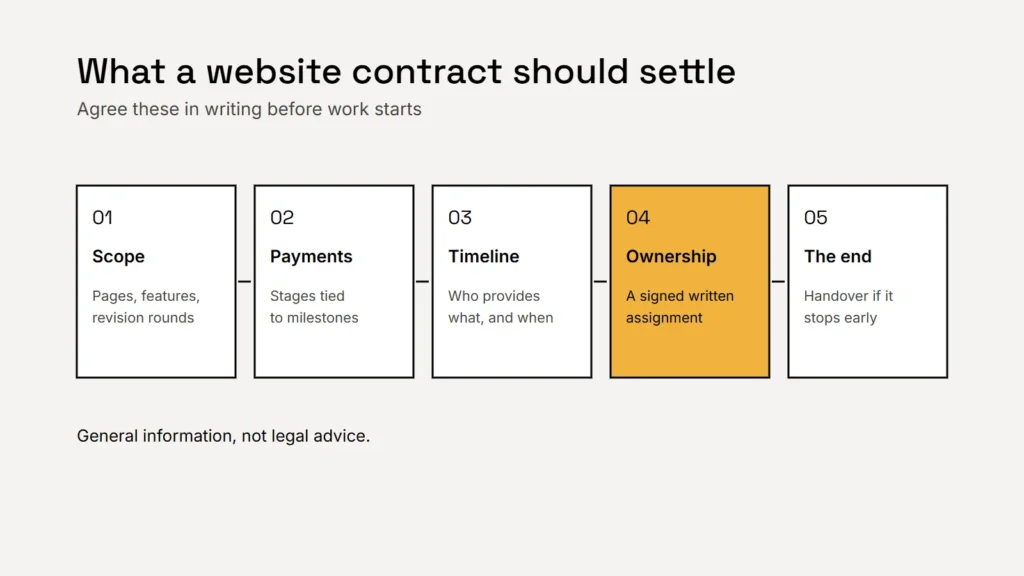
This is general information, not legal advice. For anything you’re unsure about, ask a lawyer to review the contract before you sign.
Scope: exactly what you’re buying
- The number of pages, and which ones.
- Features, such as forms, booking, a blog or online payments.
- Who writes the words and supplies the photos, and what happens if they arrive late.
- How many rounds of design changes are included.
- How extra requests are handled: ideally a written change request with a price, agreed before work starts.
Key takeaway
If it isn’t written in the scope, assume it isn’t included.
Price, payments and timeline
Look for a fixed price or a clear estimate, a payment schedule tied to stages such as design approval and launch, and a timeline that says what each side must provide and by when. A good contract also says what happens to the timeline if feedback or content is delayed, so neither side is blamed for the other’s wait.
Ownership: the clause that matters most
Paying for a website doesn’t automatically make you the copyright owner. Under US law, a commissioned work only counts as “made for hire” in nine specific categories, with a written agreement signed by both sides, and a website usually doesn’t fit them. The more reliable route is an assignment: the Copyright Act says a transfer of copyright ownership must be in writing and signed by the owner of the rights.
- An assignment of the design, content and code made for you, usually once you’ve paid in full.
- Third party items listed separately, such as themes, plugins, fonts and stock photos, with who holds each license.
- The designer’s own tools, such as reusable code they use for every client, licensed to you so you can keep using your site.
Our guide to who owns your logo, website and photos explains this in more detail.
Ownership should be a sentence in the contract, not an assumption.
Accounts and running costs
The contract should say that your domain, hosting and key accounts are registered in your business’s name, with your own logins. It should also list the running costs you’ll pay after launch, such as the domain, hosting, paid plugins and any care plan, so the yearly cost is clear from the start.
Testing, launch and support
- Which phones, tablets and browsers the site will be tested on.
- An accessibility standard the build aims for, such as WCAG 2.2 level AA. Our ADA and accessibility guide explains why it matters.
- A period after launch when bugs are fixed at no extra cost.
- What ongoing support costs, if you want it, and that it’s optional.
If the project ends early
Ask what happens if either side stops partway through: what you pay for the work done so far, and which files and accounts you receive. A contract that answers this calmly is a good sign about the people behind it.
| Clause | Look for | Be careful if |
|---|---|---|
| Scope | Pages, features and revision rounds listed | It only says “a website” |
| Payments | Stages tied to clear milestones | Most of the price is due before any design |
| Ownership | A written assignment once paid | It’s missing, or the designer keeps everything |
| Accounts | Domain and hosting in your name | Everything sits in the designer’s account |
| Running costs | Every yearly cost listed | Hosting or licenses only appear after launch |
| Ending early | Payment for work done, and a handover | It isn’t mentioned |
Checklist
- A written scope and change process.
- Payments tied to milestones.
- A timeline that covers delays on both sides.
- A signed copyright assignment once paid.
- Accounts in your name.
- Every running cost listed.
- A clear handover if it ends early.
Related service
Fixed price website packages with the scope, running costs and ownership written down before work starts. You own your domain, your content and your finished site.